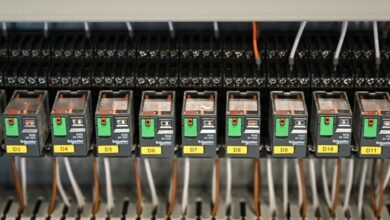
AetherLink Intelligence Capsule – 9153045811, 18449770990, 6067431456, 3.6.67.144, 18005588321


The AetherLink Intelligence Capsule integrates a set of nodes—9153045811, 18449770990, 6067431456, plus the 3.6.67.144 protocol and 18005588321—to form a modular, cryptographically bounded edge system. Its design emphasizes deterministic scheduling, adaptive buffering, and lightweight consensus to sustain low-latency data fusion across distributed peers. The goal is resilient, privacy-centric governance with locality and data sovereignty, even under irregular connectivity. The implications for edge decisioning and real-time intelligence invite scrutiny as architectures evolve and governance evolves.
What Is the AetherLink Intelligence Capsule?
The AetherLink Intelligence Capsule is a compact, data-driven device designed to enable secure, real-time information exchange within distributed networks. It functions as a modular node, aggregating signals and enforcing cryptographic boundaries.
Analysts note privacy concerns and data governance implications, emphasizing transparent logging, auditable access, and policy-aligned data flows.
How the 9153045811 and Other Nodes Drive Distributed Intelligence
How do the 9153045811 node and its peers coordinate to steer distributed intelligence across the network? Observed workflows reveal decentralized decision cycles, cross-node data fusion, and adaptive load distribution. Nodes synchronize state via lightweight consensus, enabling continual model updates.
The approach emphasizes distributed intelligence while preserving edge resilience, reducing central bottlenecks, and sustaining performance under irregular connectivity.
The 3.6.67.144 Protocol: Real-Time Data Flow and Edge Resilience
Could real-time data flow be the linchpin of edge resilience within the 3.6.67.144 protocol? The analysis centers on persistent low-latency channels, deterministic scheduling, and adaptive buffering. Real time dataflow enables rapid anomaly detection, localized decisioning, and resilient fallback paths. Quantified metrics indicate reduced jitter, improved fault tolerance, and clearer operational transparency for autonomous edge ecosystems.
Use Cases and Architectures: Deploying Smarter Solutions With Confidence
In deploying smarter solutions with confidence, organizations leverage curated use cases and scalable architectures that align with the 3.6.67.144 paradigm of real-time data flow and edge resilience.
Use cases reveal measurable outcomes, while architectures emphasize modularity, security, and locality.
Innovation ethics and data sovereignty guide governance, risk, and compliance, enabling transparent decision-making and resilient, freedom-supporting deployments.
Frequently Asked Questions
How Is Data Privacy Protected Across Aetherlink Capsules?
The analysis indicates data privacy is safeguarded through rigorous data governance and privacy by design, minimizing exposure, enforcing access controls, and auditing usage. This approach balances autonomy with accountability, supporting a freedom-driven yet responsible data ecosystem.
What Are the Hardware Requirements for Full Deployment?
Hardware deployment requires robust compute clusters, redundant storage, and secure enclaves; privacy safeguards demand end-to-end encryption, hardware attestation, and strict access policies. Data throughput scales linearly, while monitoring and auditing remain critical for continual compliance and risk reduction.
Can Capsules Operate Offline Without Network Access?
Yes, capsules can operate offline with limited functionality; ongoing data synchronization occurs when connectivity returns, enabling offline capabilities while preserving data integrity and eventual consistency across deployed nodes.
How Is Update Integrity Verified Across Nodes?
Update integrity is verified through cryptographic hashes and consensus checks across nodes, ensuring tamper detection and reproducible results; data privacy is preserved via selective disclosure and encryption, enabling trust without compromising individual autonomy or operational transparency.
What Are Licensing and Cost Implications for Enterprises?
Licensing models and cost structures vary; enterprises weigh upfront fees against subscription, tiered access, and usage caps. Juxtaposition reveals savings versus risk, with scalability offsetting administration. The analysis favors transparent governance, predictable budgeting, and freedom to adapt usage.
Conclusion
The AetherLink Intelligence Capsule demonstrates a data-driven, modular approach to real-time, edge-aligned intelligence. By integrating diverse nodes and a resilient protocol, it sustains low-latency fusion under intermittent connectivity while preserving data sovereignty. A hypothetical case: a distributed manufacturing network uses the capsule to fuse sensor streams locally, then synchronizes models across sites, ensuring rapid anomaly detection without centralized data exposure. This architecture emphasizes transparency, deterministic scheduling, and lightweight consensus to drive dependable edge decisioning.